

An Interview with a Lead Quantitative Developer
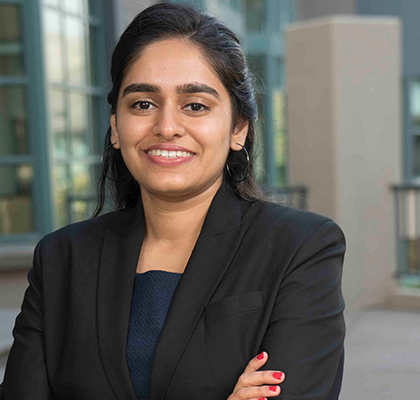
CQF alumna, Chandni Bhatia, is a Vice President and Lead Quantitative Developer at JP Morgan in the US. She is currently working with the wholesale credit division, where she leads engineering of credit risk models for global stress testing and regulatory frameworks. We spoke to Chandni about her career to date and what’s next for AI in quant finance.
What inspired you to pursue a career as a quant and how did you get started?
My background is in electrical engineering. What drew me towards quantitative finance was the realization that the mathematical and computational thinking I was developing as an engineer also mapped to quantitative financial problems, but with much higher real-world stakes. My first exposure to the quant world was at the Reserve Bank of India, where the experience of doing econometric research that fed into policy decision making at the national level showed me how risk management and quantitative work could be. From there I moved on to credit risk modeling at Credit Suisse, and then into quantitative development at Morgan Stanley.
I think the CQF genuinely helped me accelerate my career.
How did the CQF program impact your career trajectory?
The CQF was particularly valuable because it gave me a formal, structured grounding in financial engineering concepts. I was already applying them in practice but hadn't learned about them systematically before. I was working in the quantitative field at that time and pursued the program alongside my credit modeling role at Credit Suisse, so I was able to connect what I was learning in the program to real problems immediately. It also gave me a professional credential, which is a good signal to employers that you are really interested in pursuing a career in quantitative finance, particularly at an institution or a European bank where it is recognized as an international standard. I think the CQF genuinely helped me accelerate my career.
Can you describe a typical working day in your role?
My days are quite varied, which is something I like a lot. Typically, they might involve reviewing model implementation for our stress testing engines, working with risk officers to understand a new regulatory requirement and translating it into a particular or specific technical specification, or partnering with senior leadership to present updates on modern infrastructure. What I most enjoy is the translation work, where I take a complex financial problem and then present it as an engineering scalable solution.
What is the most interesting or challenging project you've worked on?
The most challenging work has been engineering the credit risk models into a large-scale stress testing engine. It requires technical skill and a deep understanding of regulatory documents. It also requires knowledge of the operational reliability that has to be achieved whilst maintaining a global scale on a tight deadline. The consequences of getting it wrong are significant and the stakes are considerably high. We need to have regulatory accountability for those outputs, and the failure of a model is something that we really can't afford in that context. Navigating that tension is generally a hard problem right now.
The CQF doesn't let you stay abstract; you are expected to apply those concepts. This habit of thinking is something I use every day.
What skills or knowledge gained from the CQF do you find most valuable in your role?
I think two things stand out. First is the rigorous treatment of moderate risk and validation. So, not just building models, but also stress testing them, challenging their assumptions, and documenting their essence for regulatory purposes. This has been directly applicable throughout my career and something that I learned during the CQF. Second would be the discipline of connecting theory to implementation. The CQF doesn't let you stay abstract; you are expected to apply those concepts. This habit of thinking is something I use every day. You have to come up with new ideas to implement a model at such a large scale at a global bank.
How are you using AI in your current role?
From what I have seen across the industry, AI has been adopted actively and with a lot of care. In my view, there's a significant potential of advanced modeling capabilities to be integrated within the financial infrastructure. Across the field, practitioners are exploring intelligent tools that can streamline complex risk processes and improve how they are implemented and explained. What's becoming clear from an industry perspective is that the technical capability of newer modeling approaches has raced ahead of the governance frameworks that were designed to oversee them. As an example, the current Federal Reserve model risk governance was developed in 2011, well before many of these approaches actually existed. It wasn't designed for the system that could produce nondeterministic outputs. I think this gap between what these tools can do and what existing framework can govern is something the entire industry is grappling with. It's one of the areas I find personally motivating to think about, particularly around scenarios where models can be made more efficient or where they can be used for simplifying the risk calculation.
What do you think will be the next big topic for AI and quant finance?
I think it will be the evolution of how the industry builds and deploys advanced models within complex financial systems. The models themselves are becoming more powerful, but the real challenge is making sure they are transparent, explainable, and robust enough to be trusted in production environments. The next frontier, in my personal view, is bridging the gap between what these models can achieve technically and how confidently we can rely on them for particular decisions, like stress testing and risk measurement, that require deep technical knowledge and a strong understanding of financial context. This is exactly the combination that quantitative finance practitioners bring to the table, not just through implementation but through thought leadership and published work that can shape the direction of the field over the next 5 to 10 years.
What advice would you give to someone looking to enter this field?
Three things come to my mind. First is to have a general technical depth, not just the tool familiarity, but the ability to understand what's happening inside a model and why is it happening. Serious institutions can quickly tell the difference whether it's a familiarity that you have, or if you have a genuine technical depth about it. Second would be to develop regulatory literacy early on, because the most interesting and most well compensated work in quantitative finance sits at the intersection of modeling and regulatory compliance. Understanding this landscape will help you differentiate yourself from others. And then third would be to write and publish; this will force you to develop these ideas rigorously, it builds your professional profile and opens the doors more than technical credentials will do alone. You don't have to be in academia to contribute meaningfully to this field.
Find out more about careers in quantitative finance
Download the Careers Guide to Quantitative Finance to learn more about the typical skills needed and salaries earned across six quantitative finance career paths.