
Delivered By
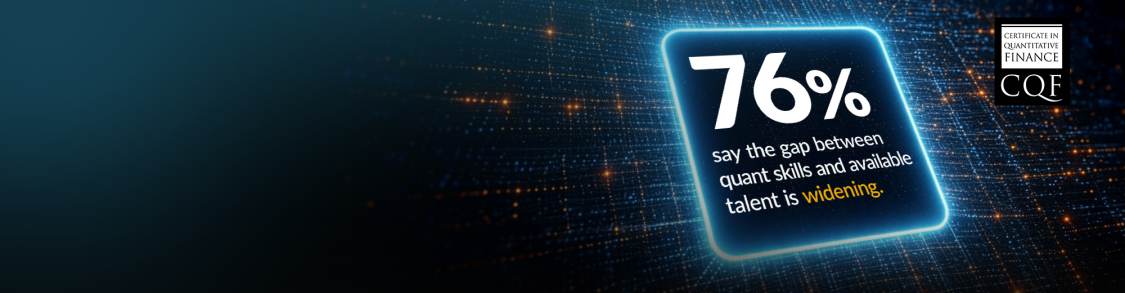
76% of Quant Finance Professionals say the Skills Gap is Widening. Here's How to Stay Ahead.
Artificial intelligence (AI) is changing the technical foundations of quantitative finance - and exposing a growing mismatch between the skills firms need and the talent available.
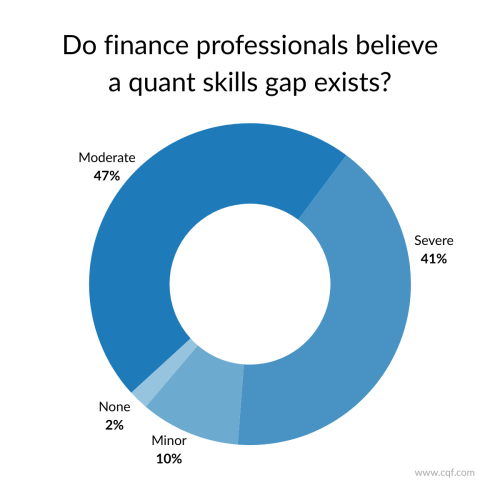
According to new research from the CQF Institute (the awarding body of the Certificate in Quantitative Finance), nearly nine in ten quantitative finance professionals believe the industry is facing a skills gap. More than three‑quarters say that gap has widened in recent years, as AI becomes embedded across trading, risk management, and investment decision‑making.
The findings suggest that the challenge is not cyclical, nor limited to hiring conditions. Instead, they point to a structural shift in how quantitative finance work is performed - and what it now demands from the workforce.
Key findings:
- 88% believe a quant skills gap exists across finance
- 76% say the gap has widened in recent years
AI is Expanding the Technical Demands of Quant Finance Roles
AI has long been associated with efficiency and automation. In practice, its impact on quantitative finance has been more complex.
Survey respondents report that AI is now embedded in core professional workflows. Its use extends beyond experimental modelling or niche research tasks, and into everyday activities that underpin analysis, development, and communication across finance teams.
The most common applications of AI reflect this shift. Professionals cite using AI tools to support code development, accelerate research and data analysis, and assist with the production of reports and documentation.
Top uses of AI in quant finance
- Code writing and debugging (18%)
- Research and analysis (16%)
- Data analysis (12%)
- Report writing (11%)
As AI becomes a routine part of these workflows, the technical bar rises accordingly. Professionals are expected not only to use AI tools, but to understand the models behind them, validate outputs, and integrate them into production environments.
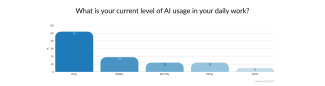
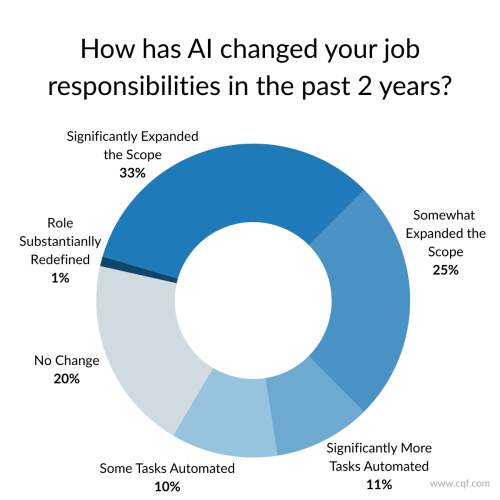
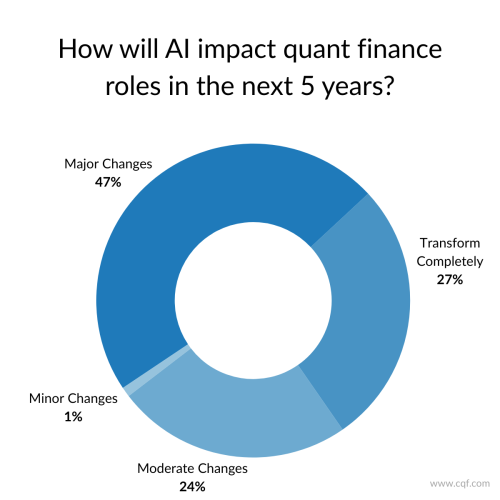
This shift is reflected in the survey data. More than half of respondents say they now use AI daily, and a similar proportion report that AI has expanded their job responsibilities over the past two years. Looking ahead, nearly three‑quarters expect AI to significantly change or completely transform quant roles within the next five years.
Key findings:
- 52% of quant professionals now use AI daily in their work
- 59% say AI has expanded their job responsibilities already
- 74% predict that AI will drive major or complete transformation for quant roles within the next five years
This rapid expansion in AI deployment is raising concerns about oversight and governance. As AI becomes more deeply embedded in financial operations, 39% of respondents identify increased reliance on automated systems without sufficient human supervision as the greatest risk to the industry. This underscores why the skills gap matters: without professionals who can properly validate, govern, and oversee AI systems, firms risk deploying technology faster than they can manage it safely. The expanding technical demands aren't just about keeping pace with innovation - they're about ensuring that AI in finance remains properly understood and controlled.
Demand for Quant Talent is Outpacing Supply
As AI becomes embedded across financial modelling, trading, and risk functions, firms are finding it increasingly difficult to source professionals with the depth of quantitative expertise now required.
What is emerging is not simply a competition for more hires, but a growing strain on the availability of professionals who can operate at the intersection of finance, machine learning, and production‑level engineering. As models become more complex and AI systems move from research into live environments, the technical threshold for many roles has risen.
“AI is raising the technical bar across quant finance,” says Dr. Randeep Gug, Managing Director of the CQF Institute. “Financial institutions are discovering that deploying advanced AI systems requires far more professionals with strong quantitative and computational foundations than the market currently produces. The result is a clear and growing shortage of talent capable of operating at the intersection of finance, data science, and machine learning.”
Hiring Pressure is Increasing
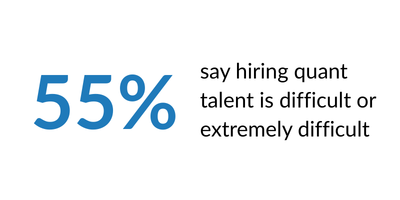
More than half of survey respondents (55%) say that hiring strong quant professionals is now difficult or extremely difficult. The challenge is most acute in roles that combine theoretical knowledge with practical implementation - particularly where models must be built, tested, deployed, and governed at scale.
These pressures suggest that demand for advanced quantitative capability is rising faster than the supply of professionals able to meet it.
Respondents identify several roles as especially hard to fill, reflecting the increasing convergence of quantitative finance, software development, and machine learning.
Hardest roles to fill:
- Quant Developer (22%)
- Quant Researcher (18%)
- Machine Learning Engineer (16%)
Scarcity of Advanced Technical Skills
Beyond job titles, respondents point to shortages in specific technical capabilities that have become critical as AI adoption deepens.
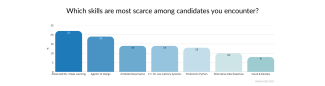
Advanced machine learning techniques top the list, followed closely by agentic AI system design and AI model governance - areas that require both strong mathematical foundations and practical experience with real‑world systems. Production‑level programming skills, particularly in Python and low‑latency C++, are also cited as difficult to source.
Most scarce skills:
- Advanced Machine Learning (22%)
- Agentic AI design (19%)
- AI model governance (14%)
- Low‑latency C++ systems (14%)
- Production Python (13%)
Taken together, the data suggests that the quant skills gap is being shaped as much by depth and specialization as by overall headcount. As AI systems become more central to financial operations, the industry’s demand is increasingly concentrated on a narrow set of high‑end technical capabilities.
Where Education and Industry Requirements are Diverging
Many professionals describe the widening skills gap as a consequence of how quickly finance roles are evolving, rather than a shortcoming of formal education. Survey respondents report that the technical scope of their current roles now extends beyond what was typically covered in university programs at the time they studied. Three‑quarters say their job requires capabilities they were not formally taught, while nine in ten believe that academic education does not fully reflect the technological demands of modern finance - particularly as AI becomes more widely used across the industry.
This skills mismatch extends to new graduates entering the workforce. Earlier CQF Institute research from 2025 found that fewer than 9% of quantitative finance professionals believe new graduates are well equipped with the AI and machine learning skills required for modern quant roles - even as 83% of professionals reported already using or developing AI tools across their work.
The areas where professionals report the greatest learning gap are those most closely associated with recent advances in AI and production‑level implementation. These include advanced machine learning techniques, AI system design, and deploying models into live environments - capabilities that have grown in importance as AI moves from research into operational use.
Education and skills alignment
- 75% say their role requires skills not taught at university
- 10% say university education keeps pace with industry needs
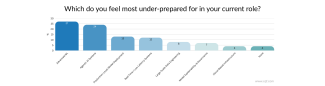
Areas where professionals report the greatest learning gap:
- Advanced Machine Learning (27%)
- Agentic AI systems (24%)
- Production model deployment (13%)
As finance roles evolve and technical requirements expand, this has increased the importance of postgraduate education and lifelong learning pathways that can adapt alongside industry change.
Continuous Upskilling is Essential
As the technical demands of quantitative finance expand, professionals increasingly view continuous upskilling as a baseline requirement. Survey respondents report dedicating significant time to learning alongside their roles, reflecting the extent to which new skills - particularly in AI, machine learning, and production‑level implementation - are now essential to staying effective in modern finance careers.
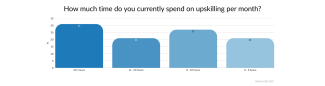
Many report dedicating significant time each month to learning, often alongside demanding workloads. Self‑directed study remains the most common approach, supplemented by professional learning resources and on‑the‑job experience.
Reskilling trends:
- 84% say continuous reskilling is mandatory
- 31% spend more than 20 hours per month upskilling
- 41% primarily rely on self‑study
Developing Skills for a Changing Quant Landscape
As quantitative finance roles evolve, professionals are increasingly looking for structured ways to build and update skills beyond traditional education. The Certificate in Quantitative Finance (CQF), awarded by the CQF Institute, is designed to address this need by focusing on applied quantitative and computational capabilities aligned with modern finance roles. The program combines core mathematical and financial modelling foundations with practical training in areas such as machine learning, programming, and model implementation - skills that survey respondents identify as increasingly essential.
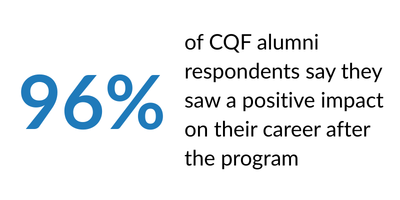
The CQF is also structured around the principle of lifelong learning. In recognition that technical requirements continue to change after formal study, alumni have access to ongoing learning resources through the CQF Lifelong Learning Library, including lectures and updates on emerging topics, as well as the latest curriculum content. This is designed to reflect the broader shift highlighted by the survey data: as AI reshapes finance roles, the ability to continuously build and renew quantitative skills is central to long‑term career relevance.
Find out more about the Certificate in Quantitative Finance
The CQF is the essential designation for professionals looking to start or advance a career in quant finance.
Download our brochure to learn more.
* Required fields
Methodology and Data Sources:
- Survey: CQF Institute Quant Finance Careers Survey (2026)
- Sample size: 135 quantitative finance professionals (global)
- Notes: Percentages rounded to whole numbers. Some questions allowed multiple selections.
For more information, images or interviews, please contact:
Leandre Morake
Leandre@aip.media