

76% of Quant Finance Professionals Say Skills Gap Is Widening as AI Reshapes Quant Roles
More than half of professionals say hiring quant talent is difficult as AI expands job demands across finance, according to a new CQF Institute survey.
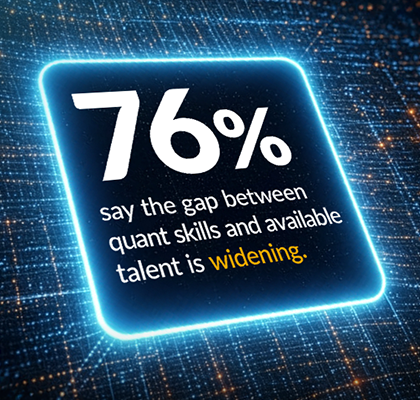
A survey by the CQF Institute, the global membership organization for quantitative finance, reveals that 76% of quantitative finance professionals believe the gap between required skills and available talent has grown in recent years, as AI expertise is increasingly expected to complement traditional quant skills.
“AI is raising the technical bar across quant finance,” says Dr. Randeep Gug, Managing Director of the CQF Institute. “Financial institutions are discovering that deploying advanced AI systems requires far more professionals with strong quantitative and computational foundations than the market currently produces. The result is a clear and growing shortage of talent capable of operating at the intersection of finance, data science, and machine learning.”
As new technologies become embedded within financial workflows, 58% of survey respondents say AI has expanded the scope of their responsibilities over the past two years, requiring deeper expertise in areas such as statistical modeling, programming, and machine learning. These changes are expected to continue, with 74% predicting that AI will drive major or complete transformation for quantitative roles within the next five years.
This rapid expansion of technical requirements is already translating into hiring challenges. More than half (55%) of respondents say that hiring strong quant professionals is difficult, pointing to a persistent shortfall of specialists with the mix of quantitative, computational, and AI skills needed to build, validate, and manage the increasingly complex models used across modern financial markets.
With 75% of professionals saying their current roles require capabilities they were never taught in university, many are relying on self-directed learning, on-the-job experience, and professional certifications, such as the Certificate in Quantitative Finance (CQF), to continuously upskill.
Overall, the findings suggest the quant finance skills gap is not a short‑term hiring challenge, but a structural issue shaped by rapid technological change. “As AI continues to reshape roles and expand job requirements, continuous reskilling is essential to keep pace with the industry’s demands,” Dr. Randeep Gug concludes.
The full CQF Institute “Careers in Quantitative Finance Survey” (2026), conducted among 135 quantitative finance professionals globally, is available here.
Survey: Fast Facts
- 88% of quantitative finance professionals globally believe a skills gap exists across the industry.
- 76% say the gap between required skills and available talent has grown in the past three years.
- 58% say AI has expanded the scope of their responsibilities over the past two years.
- 74% predict that AI will drive major or complete transformation for quant roles within the next five years.
- 55% say that hiring strong quant professionals is difficult.
- 75% say their current roles require capabilities they were never taught in university.
- 84% say that continuous reskilling is vital for a successful career in quant finance.
- 39% believe the greatest risk of the skills gap is increased reliance on automated systems without sufficient human oversight.
The findings build upon earlier CQF Institute research from 2025, which found that fewer than 9% of quantitative finance professionals believe new graduates are well equipped with the artificial intelligence and machine learning skills required for modern quant roles.